
conseil · 30 March 2026
Engineered vs solid hardwood in 2026 · a decision guide
Engineered or solid? The deciding factor is no longer price — it is dimensional stability, longevity and use. A decision guide for architects and project owners.
Sevasol
Since 1990 · 73 · 74 · 01 · 38
This question comes up at every project kick-off. The honest answer in two sentences: engineered hardwood dominates 80% of practical applications in 2026; solid hardwood retains a specific, high-cost use case. Here is how we decide, project by project, after 35 years in Savoie.
A structural difference, not a quality difference
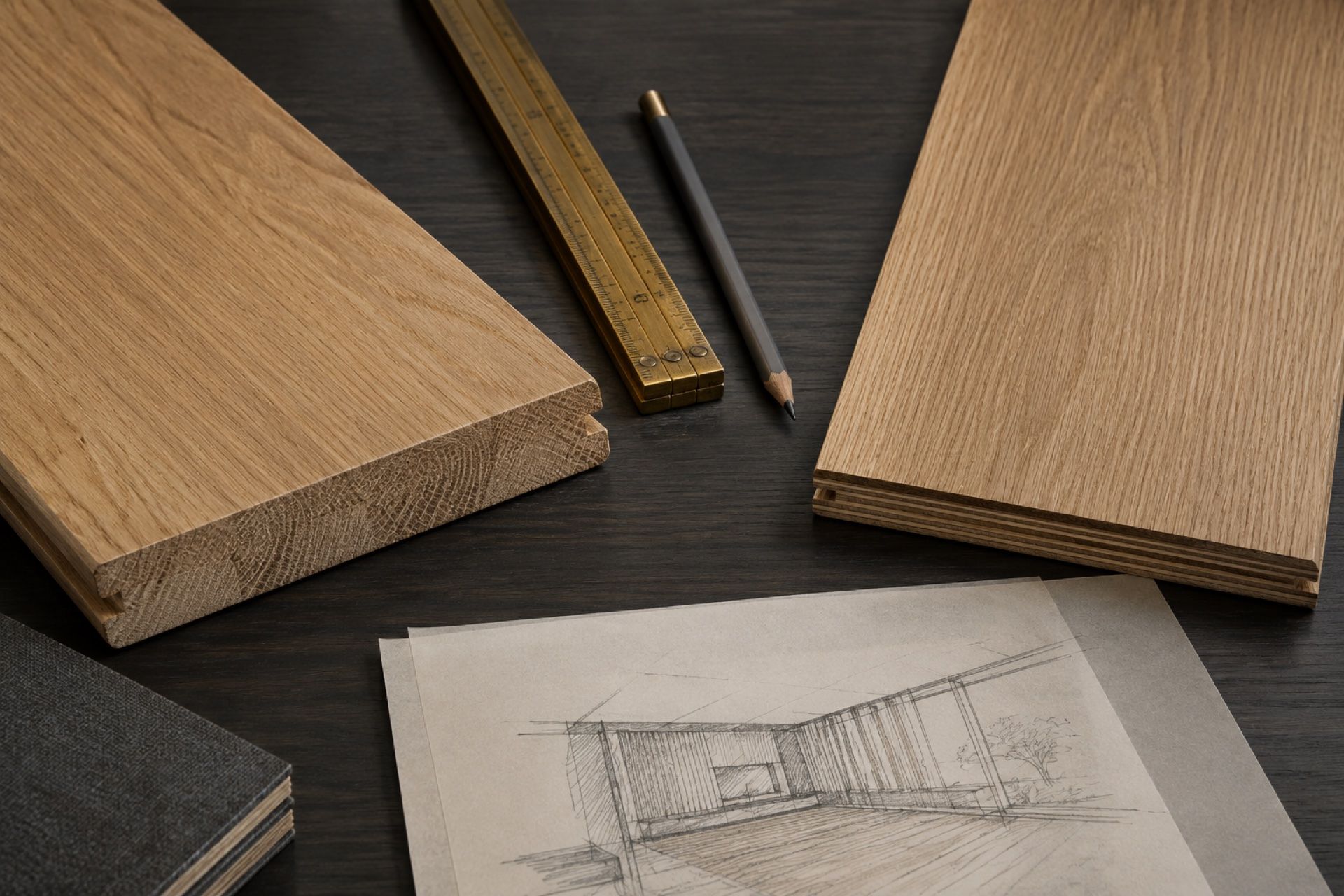
Solid hardwood is a single-species full-thickness board (14–23 mm). Engineered hardwood has three cross-bonded layers: a wear layer in noble wood (2.5–6 mm), an HDF or plywood core, and a backing veneer. Total thickness 10–15 mm. The engineered board is more dimensionally stable; the solid board is more re-sandable. Everything else follows from that.
Underfloor heating: a clear verdict
Low-temperature underfloor heating (PCBT) is now standard in new-build in Savoie. Engineered hardwood accepts this without restriction — widths up to 220 mm, wide species choice, R ≤ 0.15 m².K/W. Solid hardwood on PCBT is technically possible but constrained: width ≤ 90 mm, stable species (oak only), full-bed bonding with certified polymer adhesive, slow temperature ramp-up in year one.
The three-question decision
1. Is PCBT installed or planned? Yes → engineered (95% of cases). 2. Expected service life ≥ 50 years? Yes → solid 22 mm worth the 40% premium. Typical case: family home, prestige tertiary. 3. Target board width ≥ 180 mm? Yes → engineered. Solid at wide widths becomes unstable and very expensive.